REVIEW · PORTO
Porto private night Tour, discover the most iconic attractions
Book on Viator →Operated by Endless Weekend Tours · Bookable on Viator
Porto at night feels like a secret you can walk into. This private evening tour strings together the city’s top landmarks with a guide’s context, so you see more than lit-up buildings—you understand what you’re looking at. You’ll cover major sights from the historic core toward the Douro riverfront, with time for photos and a smooth, no-drama flow.
I really love the onboard Wi‑Fi and comfort in the vehicle—use it to check photos, pin locations, or plan your next stop without fumbling with data. I also like how the guiding style focuses on clarity and practical tips; guides like Carlos are specifically praised for being punctual and for packing a lot of explanation into a tour that doesn’t feel rushed.
One possible drawback: several standout stops have optional paid entry (like the tower and some churches/monuments). If you want to go inside everything, you’ll want a bit of extra cash and realistic expectations about how much fits into a 3-hour window.
In This Review
- Key things worth knowing before you go
- Price and what you actually get in a 3-hour Porto night tour
- The ride: pickup, comfort, and Wi‑Fi for photo-stop timing
- Start point scenery: D. Pedro Square and Avenida dos Aliados energy
- Mercado do Bolhão at night: a classic market, not just a photo stop
- Praça da Batalha and Teatro São João: history tied to the urban grid
- City walls, then cathedrals: Muralha Fernandina and Porto’s medieval core
- São Bento station tiles: the quickest way to fall in love with Porto
- Café Majestic and the Galerias Palladium clock: Belle Époque mood
- Churches and the “hidden house” story: Igreja do Carmo, Carmelitas, and Casa Escondida
- Clérigos Tower and Livraria Lello: famous, but worth choosing your level
- The National Public Library area and fine-arts museum stop: culture without rushing
- Porto’s river story: bridges, Bolsa Palace, and the shifting shoreline
- Jardim do Morro, Serra do Pilar, and the viewpoint logic
- Moving on to Gaia energy: modern bridge and coastal forts
- Art in public space: Anemone sculpture and Leixões cruise port
- Serralves and Casa da Música: modern Porto at night
- Ending in the core: Praça de Mouzinho de Albuquerque and the Peninsular War monument
- Optional add-on: Fado show with Port wine (and when it fits)
- Optional add-on: Dona Antónia Port cellar tour with 5 tastings
- So who is this private night tour best for?
- Should you book this Porto private night tour?
- FAQ
- How long is the Porto private night tour?
- What does the tour cost?
- Is pickup available?
- Is this tour private?
- Is there Wi‑Fi during the tour?
- What language is the tour offered in?
- Are admission tickets included for the monuments?
- Are the fado show and Port wine tour included?
- What if the weather is bad?
- End.
Key things worth knowing before you go
- Private by design: it’s only your group, so the pace can match your interests.
- Night-friendly logistics: hotel pickup in Porto and Gaia downtown keeps you from juggling buses and timing.
- Wi‑Fi in the vehicle: handy for maps, photos, and quick planning while you move.
- Iconic sights with context: you don’t just stop—you get why each place matters.
- Many exterior photo moments: you’ll get great views even when you skip interior tickets.
- Optional add-ons nearby: you can tack on a fado show or a Port wine cellar tour if you want more culture.
Price and what you actually get in a 3-hour Porto night tour
At $184.84 per person for about 3 hours, this isn’t the cheapest way to see Porto. But private night tours live or die by value: you’re paying for pickup, a dedicated vehicle, and a guide who explains what you’re seeing instead of you wandering and guessing.
Here’s what makes that price make sense for the right group:
- You avoid coordinating public transport at night.
- You get a guided path through famous monuments (and a few quieter viewpoints) without getting swallowed by big daytime crowds.
- The vehicle setup includes Wi‑Fi, bottled water, and refreshments, plus personal accident and liability insurance.
If you’re traveling solo or as a small group, this can feel expensive. But if you’re two to four people who want a relaxed, efficient night overview, the per-person math often starts to look fair.
You can also read our reviews of more private tours in Porto

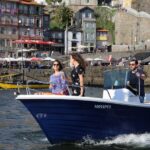
The ride: pickup, comfort, and Wi‑Fi for photo-stop timing
Your tour starts at Praça da Liberdade 19 in central Porto, and pickup is available for downtown hotels and B&Bs in both Porto and Gaia. That matters because the best night views usually come with timing—sunset light, fewer buses, and streets that feel calmer after dinner.
Inside the vehicle, you’ll have Wi‑Fi plus bottled water and refreshments. I like tours that give you this because it helps you do two very practical things:
- Quickly look up what you’re photographing so the next stop makes sense.
- Keep your phone charged and useful even if you’re on the move.
And yes, this is an English-language tour designed for most travelers, with service animals allowed. It’s also set up as a private activity, so you’re not stuck waiting on other groups.
Start point scenery: D. Pedro Square and Avenida dos Aliados energy
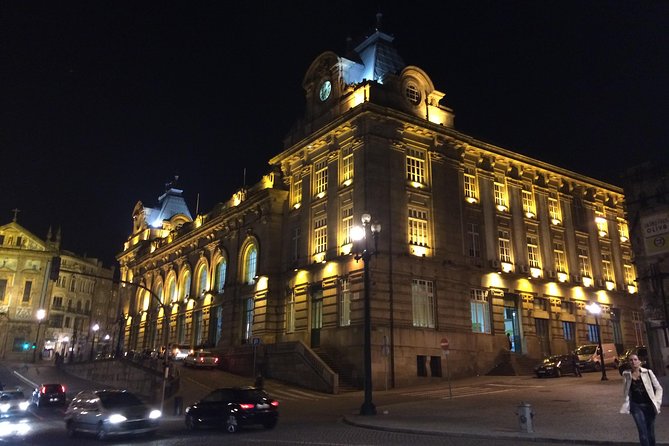
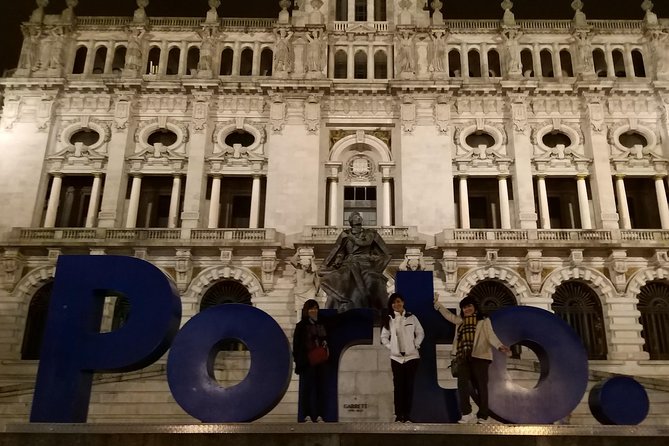
The tour opens in the historic center around D. Pedro Square, right by the area people often treat as the same continuous stretch as Avenida dos Aliados. At night, this is one of those zones where the city’s “official center” vibe still feels very walkable—wide avenues, grand building facades, and a clear sense of where to aim your camera.
You also get introduced to the statue of D. Pedro IV, the Liberator. It’s a small stop on paper, but it’s a smart way to start because you’re immediately anchored to who shaped Porto and Portugal’s identity. That kind of framing makes later churches and monuments easier to read.
Mercado do Bolhão at night: a classic market, not just a photo stop
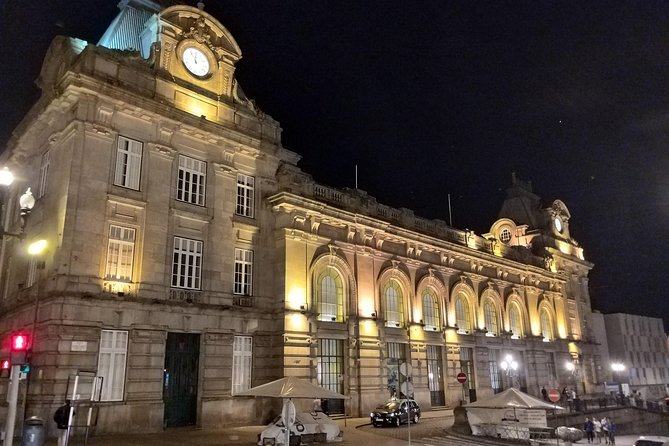
Mercado do Bolhão is one of Porto’s most recognizable markets, originally dating from 1850, with a distinctive two-floor neoclassical structure. Even if you don’t go inside for long, it’s a great night stop because the market area tells you something about daily Porto life—not just the tourist version.
This place is especially good for your first big “Porto moment” because it focuses on fresh products: fish, butcher counters, vegetables, and flowers. At night, you’re not going to get the same sensory intensity as daytime, but you will still see why the market is considered central to the city’s character.
Praça da Batalha and Teatro São João: history tied to the urban grid
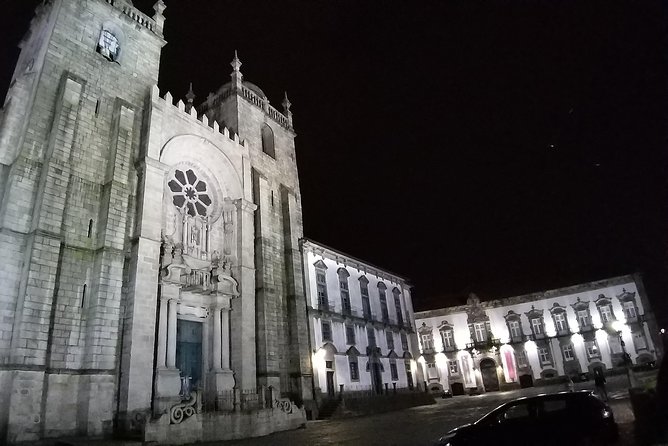
From Mercado do Bolhão, the tour heads toward Praça da Batalha, a historic square tied to an older battle and later urbanization. It’s the kind of location where you learn how Porto’s geography and street planning grew around real events, not just royal whim.
The area connects to Teatro São João, inaugurated in 1798. You’ll also hear about the theater’s fire in April 1908—a reminder that Porto’s cultural life has been rebuilt through hard times, not just enjoyed on sunny evenings.
You can also read our reviews of more evening experiences in Porto




City walls, then cathedrals: Muralha Fernandina and Porto’s medieval core
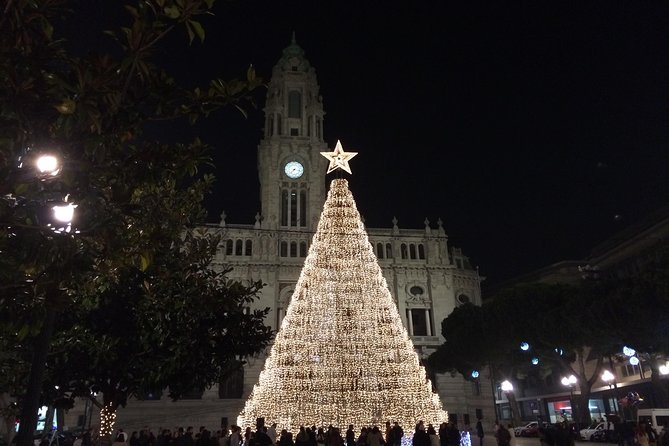
One standout early highlight is Muralha Fernandina, the medieval wall project starting in the 14th century under D. Afonso IV and continuing into later reigns. Parts were eventually demolished once the wall wasn’t needed for military purposes, which helps explain why you don’t see a complete fortification today.
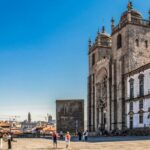
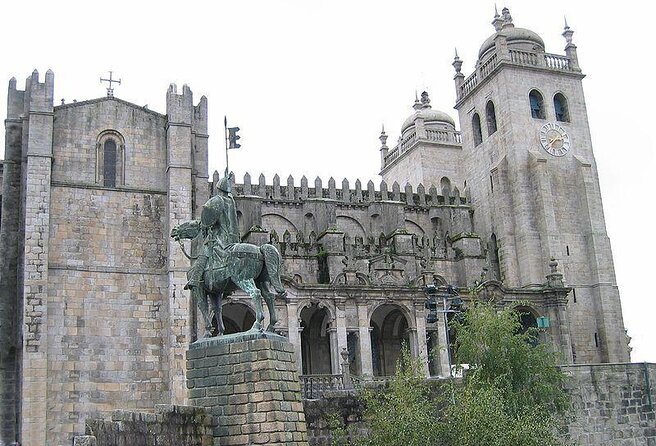
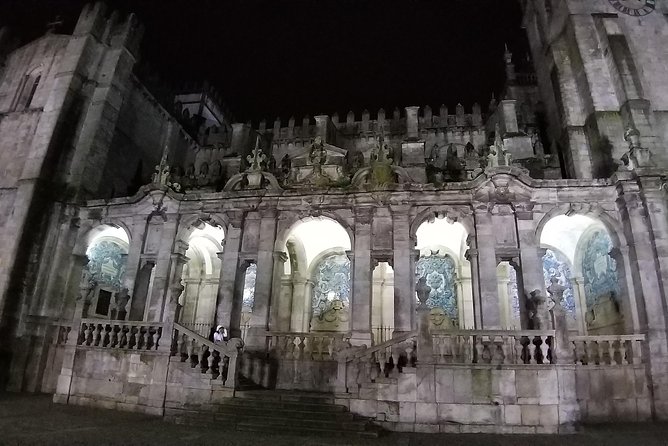
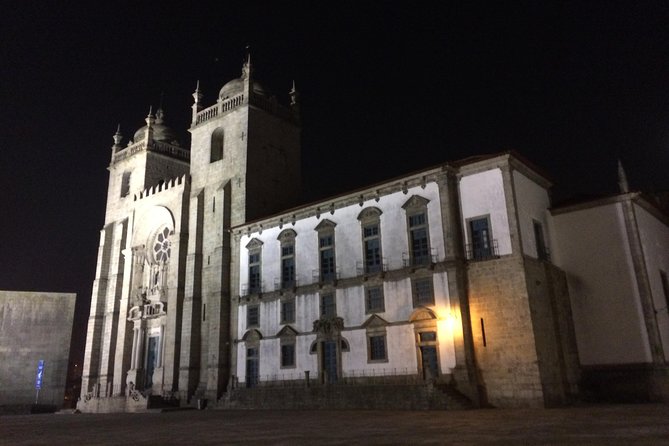
Then the tour moves to Catedral do Porto, dating from the 12th/13th century and expanded over the years. You’ll have a chance to focus on key features like the Gothic Chapel of St. John the Evangelist and cloister, plus the chancel expansion and the Chapel of the Blessed Sacrament with its silver altar.
Here’s the practical angle: entry is not included, so decide in advance whether your priorities are interior details or quick exterior appreciation. For a night tour, I like doing a short interior visit if you’re already paying for the guide—just keep it time-smart.
São Bento station tiles: the quickest way to fall in love with Porto
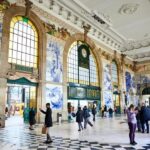
São Bento Railway Station is absolutely worth the stop. The station’s design uses glass and iron, built in the early 20th century on the old Convent of São Bento de Avé Maria site. The real star, though, is the vestibule filled with twenty thousand painted tiles by Jorge Colaço.
Those tiles narrate the evolution of transport and moments in Portuguese life. At night, you might think tiles feel too daytime-ish. They don’t. The station interior lights up the story and gives you a break from the outdoors without killing the momentum of a 3-hour tour.
Admission here is free, which makes it an easy win.
Café Majestic and the Galerias Palladium clock: Belle Époque mood
Next you’ll hit Café Majestic, opened in 1921 and a prime example of Porto’s Belle Époque era in Art Nouveau style. Marble, gilded mirrors, intricate woodwork—this is one of those places where the building itself is part of the experience.
Even if you only pause for a moment, it’s a good way to switch gears from medieval layers to 20th-century elegance. You can also connect nearby with Relógio das Galerias Palladium, an ornate clock with a carillon and four statues that perform every three hours (and play to key Porto figures).
If you time it right, the clock performance adds a fun “wow” moment without paying extra. If you miss it, the façade still looks great at night.
Churches and the “hidden house” story: Igreja do Carmo, Carmelitas, and Casa Escondida
The tour then shifts into one of my favorite styles of Porto sightseeing: stepping into baroque religious architecture and letting the streets surprise you.
You’ll see Igreja do Carmo and Igreja das Carmelitas, both baroque landmarks with standout details like azulejos on Igreja do Carmo and an ornate façade on the Carmelitas side. Right between them is Casa Escondida, often overlooked because it’s squeezed between buildings in a very practical, city-dense way.
That hidden house detail is why I like guided night tours. You might walk straight past it if you’re sightseeing on your own. With a guide, you learn how Porto’s older neighborhoods were built around space limits and creative solutions.
Clérigos Tower and Livraria Lello: famous, but worth choosing your level
Two of Porto’s biggest “name attractions” are next: Torre dos Clerigos and Livraria Lello.
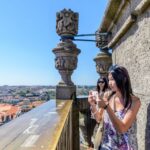
Clérigos Tower is baroque and built in the 18th century by Nicolau Nasoni. It’s one of the iconic skylines, and the top comes with a climb of 240 steps for panoramic views of Porto and the Douro. Admission is not included, so factor in cost and energy. If you’re up for the climb, it’s a night payoff because the city lights frame the river.
Livraria Lello (the building opened in 1906) is an Art Nouveau façade with Neo-Gothic details, plus an interior staircase and a stained-glass skylight. Admission is not included, so again: decide if you want to pay for the inside experience or treat it as a quick exterior-and-explain stop. Either way, knowing what you’re looking at makes the famous places feel less like a checklist.
The National Public Library area and fine-arts museum stop: culture without rushing
The tour includes a stop at the National Public Library complex, tied to the oldest public museum in Portugal. The museum function lives in a late-18th-century building installed since 1942 in the Palace of the Carrancas, with collections connected to fine arts, decorative arts, and archaeology.
This is the kind of stop that can feel optional on a night tour—until you realize it offers a different angle from bridges and towers. Even a brief visit gives your evening variety, and it’s good for anyone who wants more than just scenic photos.
If you’re short on time, you can still enjoy the setting and focus your energy on exterior views and nearby streets.
Porto’s river story: bridges, Bolsa Palace, and the shifting shoreline
At some point, you’ll start aiming toward the Douro side of the city. The big money moment here is Palacio da Bolsa (Palácio da Bolsa), designed in neoclassical style in 1842 and built on the site of a former convent destroyed in a fire after the Siege of Porto. It’s the seat of the Commercial Association of Porto, and the highlight is the famous Arab Room.
Admission is not included. If you love historic interiors, you’ll probably want to consider it. If you’re more of a skyline person, treat it as an important stop for context before the bridges.
From there, you’ll see remnants of earlier bridge design. The suspension bridge officially called D. Maria III was inaugurated in 1843 and then deactivated after four years due to insecurity concerns; today you’ll mainly see the two remaining stone pillars.
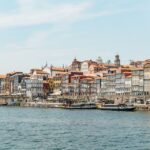
Then you’ll get the big UNESCO-level bridge viewpoints, including Ponte D. Luís I, Ponte D. Maria Pia, and nearby modern bridge elements. This is where a guided evening shines: instead of guessing which bridge was built when, you get the logic of why Porto kept replacing and upgrading river crossings.
Jardim do Morro, Serra do Pilar, and the viewpoint logic
You’ll also stop at Jardim do Morro (Hill Garden). It’s a public park with wide paths, greenery, and panoramic views. Even if you don’t plan to linger, it’s a key “reset” stop: breath, photo angle, and a clear sightline over the river.
Mosteiro da Serra do Pilar then adds the classical architecture and circular church/cloister shapes. It belongs to the Order of St. Augustine, with construction starting in 1538 and continuing for centuries with changes that altered the original design. This is also another UNESCO World Heritage tie-in when paired with the Historic Center and Luís I Bridge.
Admission is free at this stop, so you can treat it as a low-pressure cultural pause during a night packed with monuments.
Moving on to Gaia energy: modern bridge and coastal forts
The tour continues toward sights that feel more military and modern—still very Porto, just different. You’ll see the Arrábida Bridge, designed by Edgar Cardoso and inaugurated in 1963. It sits about 70 meters above average water level and has the note about being among the longest reinforced concrete bridges of its time, plus bronze sculptures on top of the four large pillars.
Then comes Fortress São João Baptista, built at the end of the 16th century to protect the coast and the Douro entrance, with later additions in the 17th century and access gate from the 18th century.
After that, you’ll stop at Castelo do Queijo (Fort São Francisco Xavier), built in the 17th century to defend against pirates and named for its rocky hill shape.
If you like your Porto with a side of defense engineering and shoreline history, this section is a strong match for you. If your night priorities are only churches and old streets, this segment may feel more “scenic context” than “must-enter interior.”
Art in public space: Anemone sculpture and Leixões cruise port
You’ll also encounter She Changes, popularly known as Anemone, made by Janet Echelman. The sculpture is a fishing-net form that moves with the wind, resembling an enormous anemone tied to the sea’s currents.
From there, Leixões Port appears in the tour as a modern port story. The tour info highlights growth in cruise operations after the new cruise pier opened in April 2011 and how cruise passengers rose sharply in 2012. It’s a reminder that Porto is not only old stone. It’s a living city with transport and tourism changing at the waterfront.
Serralves and Casa da Música: modern Porto at night
Two contemporary stops anchor your evening in a more recent Porto identity.
Serralves is an Art Deco house from the 1930s connected to Serralves Park, one of Portugal’s notable planned landscapes, with exhibitions and events housed at the property. This is a good contrast after so many medieval and baroque stops.
Then you’ll see Casa da Música, Porto’s main concert hall designed by Rem Koolhaas, inaugurated in 2005 and a contemporary architecture icon. Even from outside, it reads as a strong nighttime landmark, especially if you like modern lines after older interiors.
Ending in the core: Praça de Mouzinho de Albuquerque and the Peninsular War monument
The tour wraps through Praça de Mouzinho de Albuquerque, where you’ll see the Monument to the Heroes of the Peninsular War: a 45m high complex featuring an obelisk and groups of sculptures, representing Portugal’s union with England (lion) and victory against French Napoleonic armies (eagle).
This kind of monument works well at night because scale hits faster. You see why it’s built to be seen from a distance.
Optional add-on: Fado show with Port wine (and when it fits)
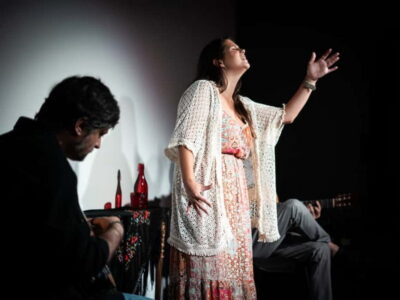
If you want the classic Porto night “final chapter,” you can add an optional fado show with Port wine. It runs for 1 hour and is scheduled daily at 18:00 and 19:30.
You’ll get fado as an Intangible Cultural Heritage-style performance, plus a Port wine tasting. Entry isn’t included in the tour price unless you book it as an add-on.
This is ideal if you enjoy music that feels tied to place. It’s also ideal if you want a night plan after the tour without needing to organize transport and ticket timing yourself.
Optional add-on: Dona Antónia Port cellar tour with 5 tastings
Another optional extension is the Dona Antónia Port wine cellar tour. It runs about 1h30 and includes a tasting of five Port wines. You’ll learn the story of Dona Antónia Adelaide Ferreira—portrayed here as the visionary woman who shaped Port wine’s destiny.
Entry isn’t included unless you add it. This is the better pick if you want something more hands-on and ingredient-focused than a music show.
So who is this private night tour best for?
This tour is a strong match if you:
- Want a high-efficiency night overview without wrestling with buses.
- Like learning what you’re seeing, not just collecting photos.
- Prefer private pacing over large-group herding.
It’s also a great choice for first-timers because it hits the major landmarks—markets, cathedral, São Bento tiles, towers, bridges, river viewpoints—within a realistic 3-hour block.
If you hate stairs or you know you’ll skip most paid entries, you can still enjoy the exterior stops. Just remember: some of the best-known monuments have extra ticket costs.
Should you book this Porto private night tour?
If you value comfort, clear explanations, and efficient night sightseeing, I think it’s an easy yes. The pickup, vehicle Wi‑Fi, and private format do real work: they reduce friction so you can focus on Porto’s streets, architecture, and river views.
Book it if your idea of a great night is mixing famous landmarks with street-level details—like São Bento tiles and the Carmo/Carmelitas area—plus bridge panoramas that explain how Porto connects across water.
One caution: if your top priority is spending lots of time inside paid sites (tower climbs, specific interiors), you may need to add extra time or accept that a 3-hour tour keeps things move-and-see.
If you want a fun question to ask yourself: do you want the city’s landmarks with context and low stress? If yes, this tour is built for that.
FAQ
How long is the Porto private night tour?
It’s about 3 hours.
What does the tour cost?
The price is $184.84 per person.
Is pickup available?
Yes. Pickup is offered for downtown hotels and B&Bs in Porto and Gaia.
Is this tour private?
Yes. It’s a private tour/activity, with only your group participating.
Is there Wi‑Fi during the tour?
Yes. The vehicle includes onboard Wi‑Fi, plus bottled water and refreshments.
What language is the tour offered in?
It’s offered in English.
Are admission tickets included for the monuments?
Some stops are free, while others are not included. For example, São Bento Railway Station is free, while entries like the Cathedral do Porto, Clérigos Tower, and Livraria Lello are not included.
Are the fado show and Port wine tour included?
No. The fado show and the Port wine cellar tour are optional add-ons. They are not included in the base tour price.
What if the weather is bad?
This experience requires good weather. If it’s canceled due to poor weather, you’ll be offered a different date or a full refund.