REVIEW · PORTO
Porto Half Day Private Tuk Tuk Tour
Book on Viator →Operated by Portuk · Bookable on Viator
Porto moves fast, so plan fast. A half-day private tuk-tuk tour is a smart way to cover real neighborhoods and major sights without burning hours on walking or parking chaos. I love the time-efficient route and the way your driver/guide can steer the day toward what you care about—views, churches, or photo stops. The best part is that a good guide turns quick look-and-go moments into actual understanding of what you’re seeing.
You should know one possible drawback upfront: when traffic or a late arrival hits, the tour can feel rushed, and you may lose some of the promised time at stops. Also, the tuk-tuk canopy can limit sightlines on gray days or in certain angles, which matters most if you hate craning your neck for photos.
What makes this work when it goes right is the human factor. Guides such as Ana, Goncalo, Rafael/Rafa, Gabi, and Bernardo show up with energy and structure, hitting key lookouts and then slowing down when you want pictures. Just have a simple goal in mind—get your bearings, see the icons, and pick what to revisit later.
In This Review
- Key things you’ll notice on this Porto half-day tuk-tuk ride
- Why a half-day tuk-tuk tour makes sense in hilly Porto
- Meeting at Rua de Augusto Rosa, and what private really means
- Teatro São João and a Romanesque wall: the “where am I?” start
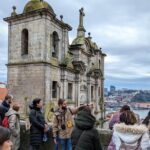
- Serra do Pilar Monastery: Porto’s circular church and the “wow terrace”
- Dom Luís I Bridge: forged iron, two decks, and the Metro link
- The Church of Gold: gilded interiors, Tree of Jesse, and catacombs
- Palácio da Bolsa and Infante Henrique: trade power in a neoclassical shell
- Jardim do Palácio de Cristal: the garden break with big city views
- Mercado Ferreira Borges and the iron architecture angle
- Alfândega Nova do Porto: the transport and communications building
- Carmelitas, Cordoaria Garden, and Torre dos Clérigos: a smooth route through iconic streets
- Igreja do Carmo tiles, Fonte dos Leões, and the prison-turned-photo center
- Livraria Lello: Art Nouveau drama in a short stop
- Wine tasting: built in, but confirm it matters to you
- Price and value: when the 3.5 hours feel worth it
- Should you book this Porto Half Day Private Tuk Tuk Tour?
- FAQ
- How long is the Porto Half Day Private Tuk Tuk Tour?
- What’s the price per person?
- Is this tour private?
- What language is the tour offered in?
- Is wine tasting included?
- Which admissions are not included in the tour price?
- Where does the tour meet, and where does it end?
- What if the weather is poor?
- How many people can fit in a tuk-tuk?
- Is there free cancellation?
Key things you’ll notice on this Porto half-day tuk-tuk ride
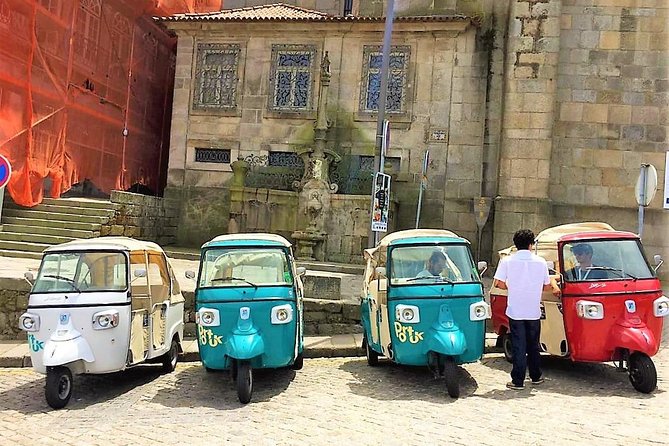
- A private pace with real context: licensed driver/guide narration, not just a loop through postcards
- Big viewpoints built into the route: Serra do Pilar and the Douro riverfront are front and center
- Church interiors get the spotlight: gold-tinged baroque/rococo moments plus catacombs
- It’s designed for hills: narrow lanes and elevation changes are easier with a tuk-tuk
- Wine tasting is part of the package—but ask if it’s important to you
- Some entrances cost extra: a few major stops are not included in admission
Why a half-day tuk-tuk tour makes sense in hilly Porto
Porto isn’t flat. Between steep streets and tight historic lanes, it’s the kind of city where you can work up a sweat fast just getting from one “must-see” to the next. A tuk-tuk helps you conserve energy for the parts of Porto you’ll want to linger over.
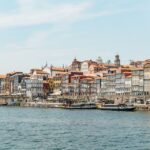
This tour is built for getting oriented. In about 3 hours 30 minutes, you can cover both sides of the Douro—Porto and Gaia—and still come away with a sense of where neighborhoods sit and how the river shapes the city. If your time is short, that’s the value: you’re not trying to do everything. You’re picking the right first pass.
You can also read our reviews of more private tours in Porto

Meeting at Rua de Augusto Rosa, and what private really means
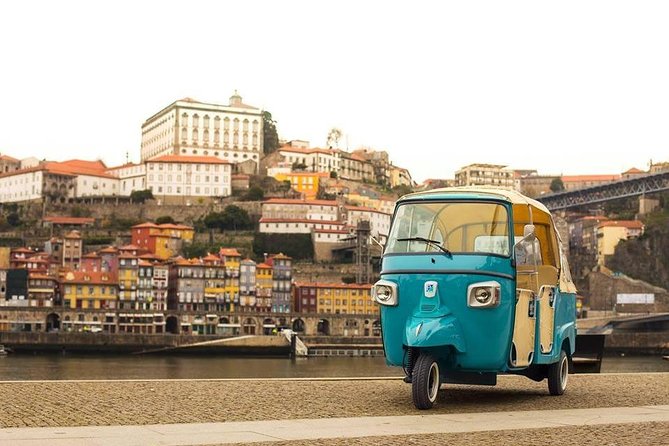
The tour starts and ends back at R. de Augusto Rosa 180 (4000-528 Porto). You’ll use a mobile ticket, and the experience is offered in English.
This is labeled as private, meaning it’s meant for just your group. In practice, the quality of a private tour depends on whether you get full time and smooth routing. If you want a stress-free start, arrive a little early, since the tour lives or dies by punctual pickup—especially when traffic decides to be unpredictable.
Teatro São João and a Romanesque wall: the “where am I?” start
Early on, you’ll see a dramatic theater building with a layered story. The structure dates from 1910, built atop older ruins after the Real Theatre burned in 1908. It’s designed by Marques da Silva, and the façade reflects a renovation style inspired by Luís XVI, a neat clue that Porto’s architecture didn’t just evolve locally—it absorbed European tastes too.
Then the route shifts to older boundaries. A Romanesque wall from the 12th century marks the administrative and urban limits of Porto during a period when population had spread out. Even if you don’t get a long stop here, it’s useful context: you’re seeing the city’s edges before you move into the denser historic core.
Serra do Pilar Monastery: Porto’s circular church and the “wow terrace”
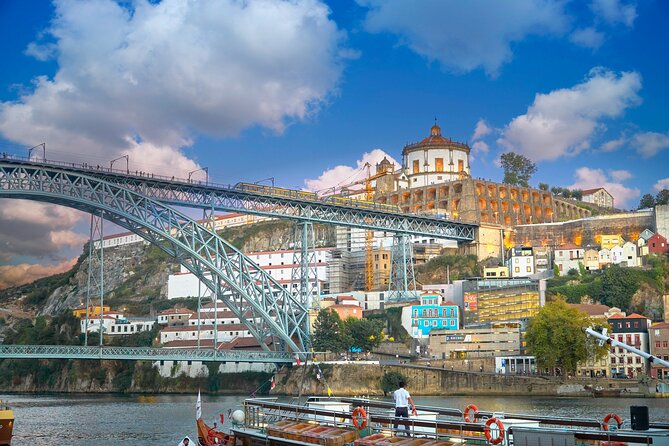
One of the best parts of this half-day plan is Mosteiro da Serra do Pilar. Construction began in 1538 and wrapped up around 1670, and it’s recognized as a World Cultural Heritage site. The church’s layout is circular, with a dome and a surrounding balcony. The cloister is also circular and features 36 Ionic columns, noted as the only example of its kind in Portugal.
The story adds weight. During the Civil War (1832–1834), the liberal army occupied the monastery. After attacks left it in bad shape, recovery efforts later brought the complex back to life, including work tied to the Royal Brotherhood of Lady of the Pilar and later friends’ groups.
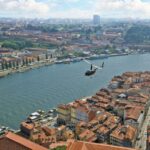
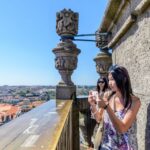
Practical tip: this stop is a great moment to take it slow. From the terrace, you get sweeping views across the riverside of Porto and Gaia, all the way toward major bridges and the historic center. If you only had time for one “big view” in Porto, this is the type of place you’d want.
Dom Luís I Bridge: forged iron, two decks, and the Metro link
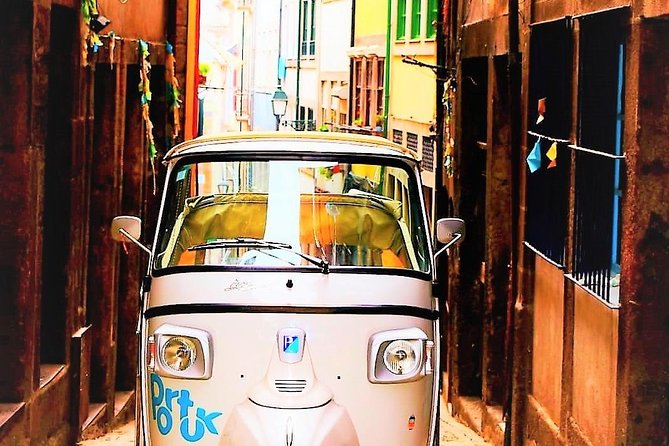
Next comes the city’s most iconic crossing: Dom Luís I Bridge. It was planned by Teófilo Seyrig, a disciple of Eiffel, and inaugurated in 1886. The bridge uses overlapping iron decks, and the arch is famously cited as the world’s biggest one in forged iron.
Today, the upper deck carries the Metro of Porto, connecting areas around Porto Cathedral toward Vila Nova de Gaia, including the Garden of Morro and the Avenida da República. Even if you don’t take the Metro, knowing that this bridge is still a working piece of infrastructure makes it feel less like a photo prop and more like part of daily Porto life.


The Church of Gold: gilded interiors, Tree of Jesse, and catacombs
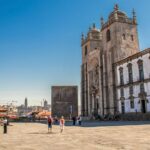
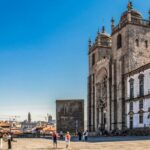
Porto’s “wow” church stop is the Gothic temple whose interior is famous for its gilded baroque/rococo splendor. Construction began in the 14th century, and the interior glow comes from carvings and gilded woodwork added in the 17th and 18th centuries. The nickname “Church of Gold” fits because the decoration is the point here.
You’ll also hear about the Tree of Jesse and the catacombs. That combination—Gothic structure outside, ornate storytelling inside, plus burial spaces—makes this one of those places where a guide helps a lot. Without guidance, you may just admire the gold and miss why those symbols matter.
If you’re short on time, focus on three things: the layout, the key symbols, and the catacomb concept. Then leave room to revisit later if you want more detail.
Palácio da Bolsa and Infante Henrique: trade power in a neoclassical shell
The next big cultural stop is Palácio da Bolsa (Stock Exchange Palace). Designed in 1842 in a neoclassical style, it sits in Porto’s historical center and connects to major civic life. If you like architecture, this is one of those buildings where the exterior gives you the frame and the interior gives you the story.
The Arabian Room is the standout highlight here. Also worth noting: this palace is part of the Urban Wine Route, which connects nicely to the tour’s wine tasting component later. If you’re someone who likes to link art, commerce, and daily culture, this is a good place to do that.
Nearby, you’ll stop at a central square area where you can see the Monument to Infante D. Henrique. The monument construction ran from 1894 to 1900, celebrating Portuguese navigation and faith. It’s a subtle but powerful reminder: Porto’s identity is tied to ships, trade, and movement—just like its architecture.
Jardim do Palácio de Cristal: the garden break with big city views
Not every moment should be a doorway and a ticket line. The Jardins do Palácio de Cristal gives you a breather. This is one of Porto’s best-loved green escapes, laid out as a mosaic of small gardens that open up as you wander—so your “walk” feels like exploration rather than a chore.
Expect lawns, sun-dappled paths, fountains, sculptures, and major plants like giant magnolias, camellias, cypress, and olive trees. As you move through, views of the city and the Douro appear at different angles, so this isn’t just a rest stop. It’s part of the sightseeing.
A small practical note: if you’re traveling in rain or strong sun, this garden stop can swing your experience. On a clear day, it’s pure pleasure. On a bad day, focus on the viewpoints and don’t fight the weather.
Mercado Ferreira Borges and the iron architecture angle
You’ll also see an iron architecture story at the market area built in 1885 under city order, meant to replace an older Ribeira Market. It didn’t stay a market forever. Over time it shifted into entertainment use, and you’ll hear it’s now associated with Hard Club.
Why care? Because Porto’s historic center isn’t only stone and tiles. It includes industrial-era design choices, and ironwork like this helps you understand how the city modernized while staying recognizable.
If you like photos: come ready with a plan. This area can be visually busy, so pick one angle, get your shot, and move on rather than trying to capture everything.
Alfândega Nova do Porto: the transport and communications building
The tour also passes by Alfândega Nova do Porto, a neoclassical building designed by engineer Jean F. G. Colson in the 19th century. It has two facades—one toward the Douro river and one facing the city—and mixes iron with other materials like stone, brick, and wood depending on the function.
Restoration and adaptation work later shaped it into a hub for the future Museum of Transport and Communications, designed with help from architect Eduardo Souto Moura. It’s also managed as a congress and event space.
Even if you don’t go inside, this stop works as “how Porto works” context. You start seeing how logistics and trade connected to the built environment, not just to shipping lanes.
Carmelitas, Cordoaria Garden, and Torre dos Clérigos: a smooth route through iconic streets
Churches and gardens come next, but in a way that keeps your legs fresh.
You’ll visit Igreja dos Carmelitas, a 17th-century church with a classical façade dating from the 1850s, attributed to Nicolau Nasoni. The altarpiece is described as Porto rococo style and marked as nationally important.
Then you hit Cordoaria Garden—also known as Jardim de João Chagas since 1924. The garden’s name links to rope makers who worked nearby for about 200 years. It’s not just a pretty patch of green: it includes statues of Ramalho Ortigão and António Nobre, plus sculptures by Juan Muñoz from 2001.
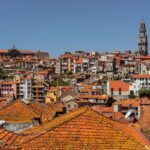
Finally, you’ll stop by Torre dos Clérigos, a baroque church tower that can be spotted from multiple parts of the city. Even without climbing, seeing it from street level helps you understand Porto’s skyline rhythm.
Igreja do Carmo tiles, Fonte dos Leões, and the prison-turned-photo center
The tour’s Porto flavor becomes very specific in this stretch.
At Igreja do Carmo, you’re looking at 18th-century rococo design. Its lateral façade was covered with tiles in 1912, and the tile drawings were designed by Silvestre Silvestri. The images connect to the cult of Nossa Senhora (Our Lady), which makes the tiles feel more intentional than decorative.
Then there’s a fountain moment: Fonte dos Leões. It’s a 19th-century fountain built by a French company, with casting done in France. It’s said to be a copy of a fountain in Leicester, which is a fun reminder that Porto’s city furniture also traveled through European ideas.
The most moving stop here is Antiga Cadeia da Relação, a granite building dating from 1582, rebuilt in 1767 in neo-classical style by Eugénio dos Santos. The polygon shape includes 103 windows, and its four façades reflect its functions. This is where the tour touches real human stories—Portuguese writer Camilo Castelo Branco and the famed “Zé do Telhado” were kept here.
Today it functions as the Portuguese Centre for Photography after restoration work. So your route shifts from beauty and symbolism to a space where art and memory share the same walls.
Livraria Lello: Art Nouveau drama in a short stop
You’ll also make time for Livraria Lello, a library building inaugurated in 1906 with an Art Nouveau façade and neo-gothic details. Inside, the decoration includes painted plaster meant to imitate wood, and the grand staircase connects the main levels.
One technical-feeling detail to look for: the staircase is among the early reinforced concrete works in Porto. There’s also a huge stained-glass skylight with the library’s monogram and motto, Decus in Labore.
Admission isn’t included for this stop, so think of this as a quick hit rather than a long session. If you care most about photos and façade details, go early in your route flow so you’re not mentally rushing.
Wine tasting: built in, but confirm it matters to you
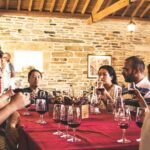
Wine tasting is listed as included, and the route also ties into wine culture through the Urban Wine Route connection at Palácio da Bolsa. That said, because tasting can depend on timing and the guide’s execution, I suggest you treat this as important enough to mention at the start.
If wine is a priority, ask a simple check-in question: when will we do the tasting, and how long should I plan for it? That keeps the day from turning into a “we saw something wine-related but didn’t taste” situation.
Price and value: when the 3.5 hours feel worth it
At $83.48 per person for about 3 hours 30 minutes, you’re paying for convenience plus interpretation: licensed local guidance, a vehicle that can reach tight lanes, and a route that aims to hit major icons without you planning the logistics.
This can be excellent value if:
- you’re on your first morning and want a quick “map in your head”
- you hate walking uphill between far-flung sights
- you want a guide to connect architecture, symbols, and neighborhood character
It can feel overpriced if:
- you end up losing time to late pickup or traffic bottlenecks
- you’re expecting museum-depth explanations at every stop
- the tour feels like a fast drive-through rather than a guided sequence
Because this is a private experience in name, you should set your own expectation: the best version of this tour gives you both coverage and time to look, not just movement.
Should you book this Porto Half Day Private Tuk Tuk Tour?
Book it if you want maximum orientation in minimal walking, especially on a rainy or windy day when umbrellas slow everything down. It’s also a strong pick for travelers who love churches and city details but don’t want to stitch together multiple bus rides and awkward taxi hops.
Skip it or think twice if you’re the type who needs deep indoor time, long museum stops, or a very rigid schedule. This tour is about flow—so if you want stop-by-stop precision, you’ll likely feel more satisfied adding a separate, targeted visit to the places that truly catch your eye.
FAQ
How long is the Porto Half Day Private Tuk Tuk Tour?
It runs for about 3 hours 30 minutes.
What’s the price per person?
The price is $83.48 per person.
Is this tour private?
Yes. It’s a private tour/activity, meaning only your group participates.
What language is the tour offered in?
The tour includes English.
Is wine tasting included?
Yes. Wine tasting is listed as included.
Which admissions are not included in the tour price?
Admission tickets are listed as not included for Torre dos Clérigos, Igreja do Carmo, and Livraria Lello. Other listed stops include free admission.
Where does the tour meet, and where does it end?
It starts at R. de Augusto Rosa 180, 4000-528 Porto and ends back at the meeting point.
What if the weather is poor?
This experience requires good weather. If it’s canceled due to poor weather, you’ll be offered a different date or a full refund.
How many people can fit in a tuk-tuk?
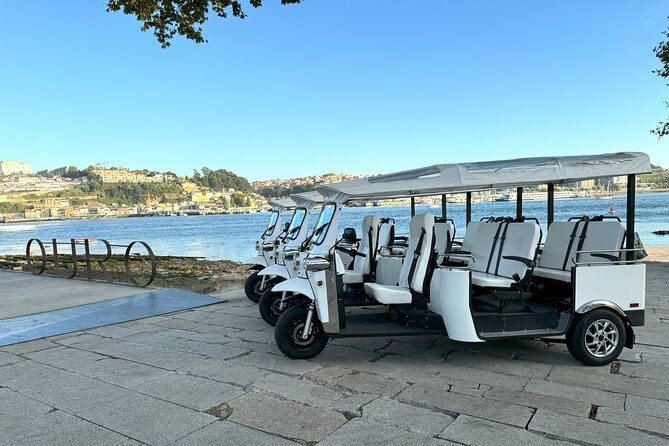
Each tuk-tuk can carry 2, 3, or 4 adults (up to 75kg per person). For larger groups, multiple vehicles are used with the same stops and timing.
Is there free cancellation?
Yes. You can cancel for a full refund up to 24 hours before the experience’s start time.