REVIEW · PORTO
Porto Guided Tour to the Historical Center on a Tuk Tuk
Book on Viator →Operated by Portuk · Bookable on Viator
Porto’s best angle is usually from a low ride. This Tuk Tuk tour packs landmark after landmark into about 2 hours, with a sip of Port wine halfway through and plenty of stops you’d miss if you only sprinted along the main streets. I love how the driver can roll into tight, cobbled lanes to reach places on foot take longer to reach. One drawback: the tour is fast, so if you want lots of long indoor visits, you’ll still need to pay for some entrances.
You’ll meet at R. de Augusto Rosa 180 and ride with a private group in English, with a local guide and a driver/guide onboard. It’s also a smart first-day move if your legs need a break, because you get both the famous stuff and the “wait, where are we?” streets that help you understand Porto’s shape.
In This Review
- Key things I’d bet on
- Tuk Tuk tempo: how you’ll experience Porto in 1h50
- Meeting at R. de Augusto Rosa and staying sane at the start
- Theatre façade and the Fernandina wall: Porto’s layered past in two stops
- Cathedral area: Romanesque bones, later changes, and a government monument
- São Bento Station: where the tiles do the talking
- Squares, lions, and two rococo church interiors (mostly from the outside)
- Rope makers’ garden to Clérigos Tower: viewpoints and baroque impact
- Livraria Lello, Palácio da Bolsa, and the feeling of Porto as a stage
- Ferreira Borges market and Infante D. Henrique: iron, navigation, and national pride
- Igreja de São Francisco: the gold interior payoff (and the catacomb add-on)
- Alfândega Nova and the iron engineering behind Porto’s waterfront
- Serra do Pilar viewpoint: the stop that explains Porto’s geography
- Dom Luís I Bridge and the modern iron arch: two eras, one crossing
- Price and value: what $42.33 buys you, and what it doesn’t
- Sound, timing, and weather: the real-world trade-offs
- Who should book the Porto historical center Tuk Tuk tour
- Should you book this Tuk Tuk tour?
- FAQ
- How long is the Tuk Tuk tour in Porto?
- Is Port wine included?
- What language is the tour offered in?
- Are entrance tickets to monuments included?
- Where does the tour start and end?
- Is this a private tour?
- How many people can fit in each Tuk Tuk?
- What if the weather is poor?
Key things I’d bet on
- Tuk Tuk access for narrow streets: you’ll see spots that are annoying to reach by car or on a hurried walk.
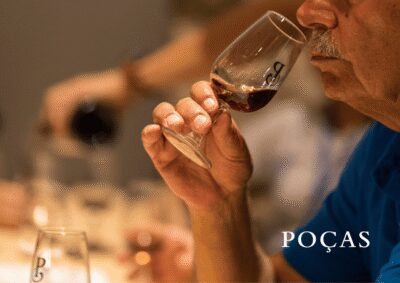
- Port wine included: a small but memorable Porto touch that breaks up the sightseeing pace.
- A lot of variety in under 2 hours: churches, stations, viewpoints, markets, bridges, and squares.
- Short stop times work for many travelers: several stops are around 5–10 minutes, so you can move on without feeling trapped.
- Some indoor entrances cost extra: the big sights with tickets aren’t always included.
- Guide quality matters: many guides are praised for energy and storytelling, but sound and traffic can affect how much you catch.
Tuk Tuk tempo: how you’ll experience Porto in 1h50
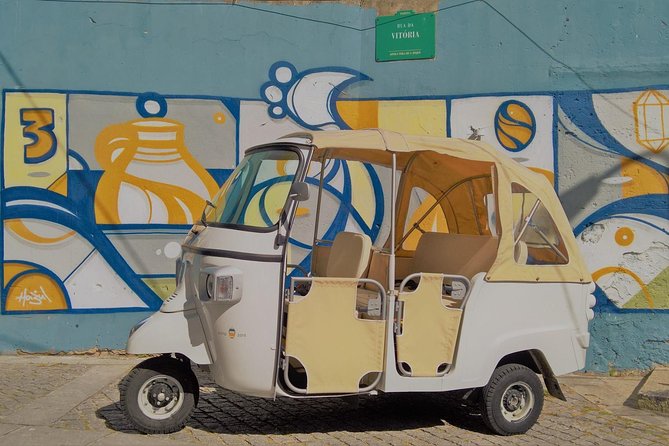
This is built for time-crunched sightseeing. You get driven between major points of interest, then you hop out for quick photo and orientation breaks—often around 5 to 10 minutes per stop—so you can cover a lot without wearing yourself out.
The Tuk Tuk format also changes the vibe. You’re sitting closer to the street, and Porto’s hills and compact streets feel more real than they do from a bus window. If you’re traveling with kids or you’re simply tired of climbing stairs after one day, this style of tour can be a relief.
A practical note: each Tuk Tuk can carry 2, 3, or 4 adults (up to 75 kg per person), and larger groups use multiple vehicles that still make the same stops at the same time. That usually keeps things smooth, but it also means you’re not sharing one big vehicle with everyone.
You can also read our reviews of more guided tours in Porto

Meeting at R. de Augusto Rosa and staying sane at the start
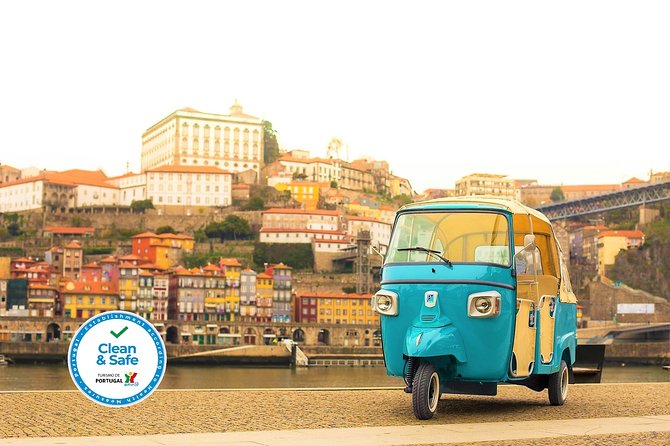
The tour starts and ends back at the meeting point at R. de Augusto Rosa 180 (4000-528 Porto). That’s straightforward, but I recommend you plan to arrive a little early so you’re not doing stress-scrolling for your ride.
From what’s shown by past guests, meeting point confusion can happen when you’re arriving for the first time, especially if you’re trying to find it while juggling bags, a stroller, or a quick change in weather. Give yourself a buffer, and you’ll start the tour in a calmer mood.
And yes, it’s a private tour/activity—so your group rides together. That matters because you’re not competing with strangers for seats, and the guide can keep an eye on timing for your pace.
Theatre façade and the Fernandina wall: Porto’s layered past in two stops
The first stretch gives you architecture that’s tied to Porto’s cultural life and its defenses.
You’ll start by seeing a 1910 classic building constructed on the ruins of the Real Theatre, which burned in 1908. The façade is described as inspired by the Luís XVI style—an early-20th-century nod to French influence—and it even carries symbolic emblems linked with themes like pain and hate, not exactly the postcard kind of decoration. It’s a good opener because it signals right away that Porto doesn’t just do pretty surfaces; it keeps telling stories in stone.
Next comes one of the city’s best “wait, why don’t more people see this?” moments: Muralha Fernandina. This is a military wall built between 1368 and 1437, using funds connected to Sisa do Vinho (a wine-related tax). You’ll learn it ran for about 3,000 steps and reaches around 30 feet on average. Even if you don’t walk the full wall, seeing it as a surviving fragment helps you understand why Porto developed the way it did—packed city, strong edges, and tight internal streets.
Cathedral area: Romanesque bones, later changes, and a government monument
The tour then moves into the cathedral complex area.
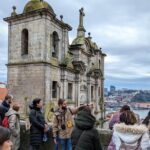
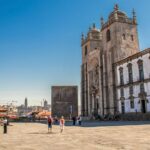
At the Catedral do Porto, you’re looking at a structure whose core dates to the 12th/13th centuries in Romanesque style, but it’s been enlarged and renewed over time, even into the 20th century. The result is an “idealized reconstitution” of what a medieval cathedral might have looked like—so you’re not just seeing one era, you’re seeing the idea of one era, preserved and adjusted through the centuries.
The next stop focuses on the Pelourinho—a stone monument placed on a terrace after buildings around the cathedral and bishop’s palace were demolished in 1940. The pelourinho monument was built in 1945 and it’s described as a reproduction of an 1797 drawing. This is the kind of detail that turns a quick cathedral stop into actual civic history: Porto’s religious heart also had its government story.
Then you’ll pass the Paco Episcopal, likely founded in the 13th century but remodeled in 1737. It’s a façade-forward stop with arches, pilasters, and a decorated fronton showing the coat of arms of Bishop D. Rafael de Mendonça. If you like noticing decorative “clues” in architecture, this one is quick but rewarding.
One thing to flag: several of these cathedral/church-related stops say admission ticket not included, so you can enjoy the exterior and the orientation, but plan on paying separately if you want to go inside.
São Bento Station: where the tiles do the talking
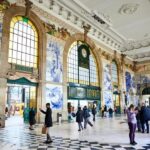
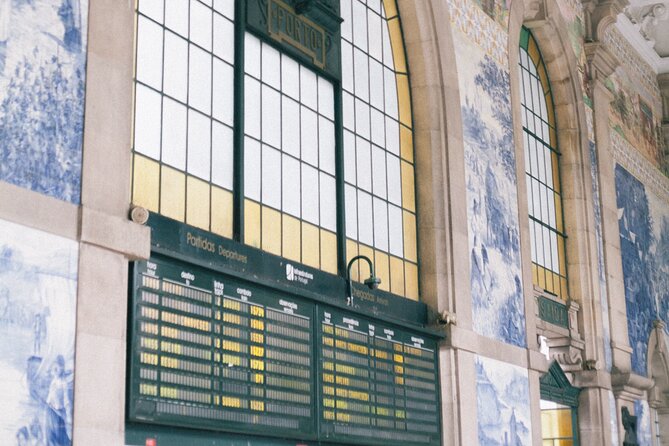
Sao Bento Railway Station is one of Porto’s most famous interiors, and you get it in a very workable way.
You’ll see the station lobby with its glass and cast iron roof, and the centerpiece is massive: around 20,000 narrative tiles painted by Jorge Colaço. The tiles aren’t abstract decoration; they tell stories, which makes the station feel like a museum you didn’t need to schedule.
The stop is about 10 minutes. That’s just enough time to take photos and skim the major panels, but not enough for deep reading. If you’re the type who likes to zoom in and read every scene, you may want to plan a return visit on another day—yet this tour gives you the context fast.
You can also read our reviews of more historical tours in Porto


Squares, lions, and two rococo church interiors (mostly from the outside)
As the tour threads through the historic center, you’ll also get the feel of Porto’s civic spaces.
One square area traces back to early 18th-century urban planning, when the project began in 1718 to create Praça Nova. That area was shaped by medieval walls and palaces that no longer exist, which explains why the square can feel slightly “sudden” in the middle of older streets.
Nearby, you’ll learn the same square was historically called Praça dos Ferradores (Square of Blacksmiths). Later, the Palace of Viscondes de Balsemão was built on the east side and later served as a guesthouse that hosted King Charles Alber from Sardinia, exiled to Porto. That’s why the square carries its later name: a single building changed the meaning of a whole block.
Then you’ll hit a classic decorative pause: Fonte dos Leões (Fountain of the Lions). It’s a 19th-century fountain built by a French company, cast in France at Val d’Osne, and it’s described as a copy of the fountain in Leicester’s Town Hall Square. That kind of detail is fun because it shows how Porto wasn’t isolated; design trends traveled.
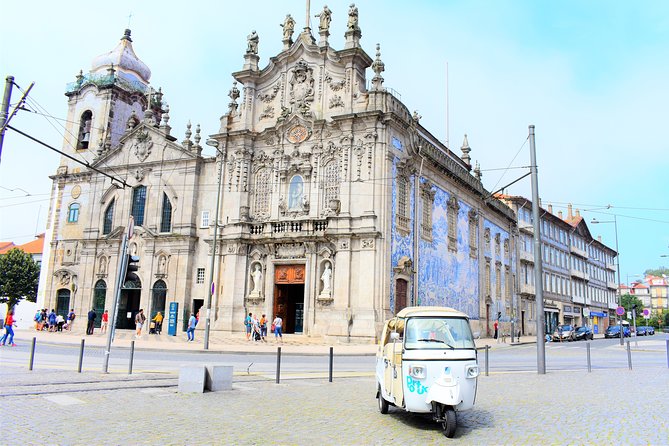
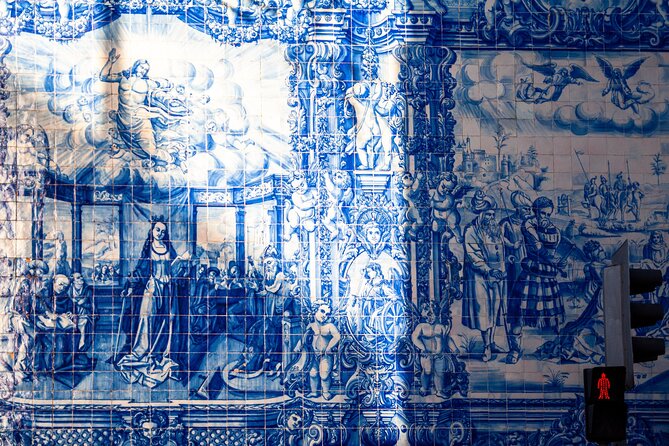
After that, you’ll see two rococo-related church stops marked as national monuments. One has a classical façade dating to the 1850s, attributed to Nicolau Nasoni, and features a Porto rococo altarpiece noted as stylistically revolutionary. The other is described as a remarkable example of Porto rococo with a lateral façade covered in tiles in 1912, designed by Silvestre Silvestri, alluding to the cult of Nossa Senhora (Our Lady). These stops are short, but they give you that key “Porto looks different in different centuries” lesson.
Rope makers’ garden to Clérigos Tower: viewpoints and baroque impact
You’ll also pass through a quieter green pocket: what’s best known as Cordoaria Garden, called João Chagas Garden since 1924.
This garden earned its fame from rope makers who worked there for about 200 years. In the 19th century the municipality transformed the area into a public space with a project by German landscaper Emile David in 1865/1866. What I like here is that it’s not just a park break; it’s a reminder that the historic center was once tied to industry. Statues of Ramalho Ortigão and António Nobre sit inside, plus sculptures by Juan Muñoz from 2001, including O rapto de Ganímedes (Kidnapping of Ganímedes).
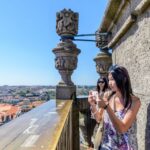
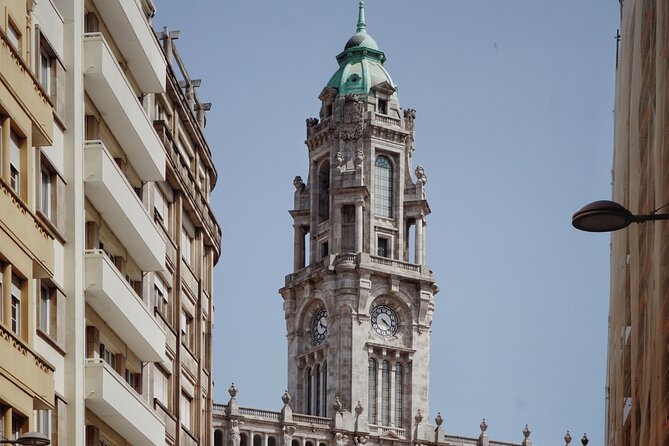
Then it’s onto Torre dos Clérigos. The Clérigos Church is Baroque, and the tower is one of Porto’s most recognizable silhouettes. This is one of those “even if you think you don’t know Porto, you’ll know this” moments.
The tour notes that the complex includes spaces used for cultural life, including the restoration and use by Benedictine monks, the Porto National Orchestra, and Porto District Archives. During Porto 2001, the Noble Cloister got an acoustic shell. If you’re curious how religious buildings keep changing roles, this is a good stop.
Livraria Lello, Palácio da Bolsa, and the feeling of Porto as a stage
A big section of the ride is about Porto’s “showy” side—buildings built to impress, not just to function.
At Palácio da Bolsa (Stock Exchange Palace), you’ll see a neoclassical building designed in 1842. The major highlight is the famous Arabian Room, and it’s also tied to the Urban Wine Route. If you like architecture that feels like theatre, this kind of space is made for you—bright, dramatic, and built when the city wanted attention.
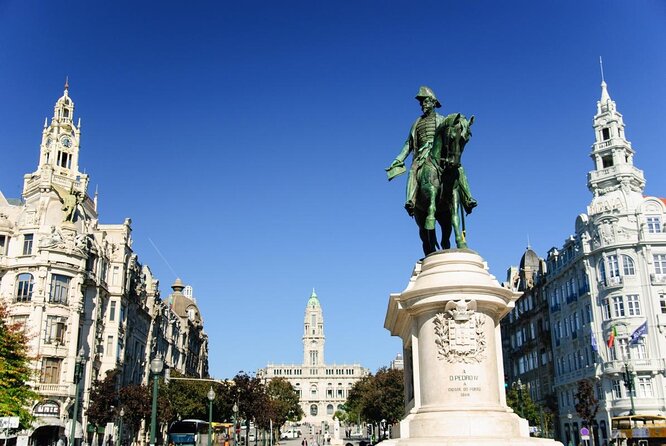
Nearby, there’s a statue connected to Dom Pedro. The monument was unveiled in October 1866 and uses a two-sided idea: one side references the donation of Dom Pedro’s heart to Porto’s representatives, the other the arrival in Mindelo. The standing figure is described as Dom Pedro offering the constitutional charter to the city, and the statue was cast in Belgium.
Then you’ll see the library building inaugurated in 1906 with an Art Nouveau façade and neo-Gothic details. Inside, it’s decorated with painted plaster that imitates wood, and the staircase is a standout, linking floors. A huge stained-glass skylight bears the library’s monogram and motto, Decus in Labore. The tour also notes international acclaim: The Guardian called it the world’s third most beautiful (as of their 2008 coverage), and Lonely Planet included it in Best in Travel 2011 with a nod to its neo-gothic shelves and staircase.
One practical note: this is a lot to pack in. Even if you enjoy buildings, the speed of the tour means you’ll want to decide whether you’re doing exterior photos only or you’re using your own time to step inside where permitted. Since some stops say admissions aren’t included, your choices will shape the “value” of your day.
Ferreira Borges market and Infante D. Henrique: iron, navigation, and national pride
After the grand interiors, you shift into something very practical: iron architecture.
The old market built in 1885 was ordered to replace the earlier Mercado da Ribeira. It operated briefly as a market and later became an entertainment venue, where Hard Club is now located. The point for you isn’t just the building; it’s the idea that Porto used industrial materials and repurposed them. You’re seeing a city that reuses and adapts.
Then comes a square area surrounded by the Mercado Ferreira Borges and Palácio da Bolsa, with a small garden and an underground car park built beneath it. There’s also a Monument to Infante D. Henrique, started in 1894 and completed in 1900, described as a triumph of Portuguese navigation and faith. If you’re building a mental map of Porto, this stop works as a “center point” reference.
Igreja de São Francisco: the gold interior payoff (and the catacomb add-on)
The tour ends this core stretch at São Francisco Church, Porto’s big Gothic statement.
Construction began in the 14th century, and the church includes a gilded Baroque interior from the 17th and 18th centuries. It’s described as one of the most important works of Baroque in Portugal, and the gilded woodwork is so dramatic it earned the nickname Church of Gold. Key features you’ll want to look for include the Tree of Jesse and the catacombs. It’s also a National Monument since 1910 and UNESCO World Cultural Heritage since 1996.
This is one of those stops where a short glance from outside won’t do it justice. If you want the full wow-factor, you’ll likely want to plan more time later (or at least expect that your interest will push you to return).
Alfândega Nova and the iron engineering behind Porto’s waterfront
Next you’ll see a strong “systems” stop: Alfândega Nova do Porto.
This 19th-century neoclassical building was designed under engineer Jean F. G. Colson and has two facades, one toward the Douro River and one toward the city. It’s noted for structural solutions that mix iron with other materials like stone, brick, or wood depending on the space’s function.
Restoration and adaptation were tied to the creation of the future Museum of Transport and Communications, with projects by architect Eduardo Souto Moura. The building also supports a Congress Centre managed by the relevant association. You won’t necessarily “feel” this museum during the quick roadside stop, but it’s valuable because you understand the city’s transport and trade identity beyond pretty streets.
Serra do Pilar viewpoint: the stop that explains Porto’s geography
Then comes one of the most praised moments: Mosteiro da Serra do Pilar.
This is UNESCO World Cultural Heritage, started in 1538 and completed around 1670. It began for Augustinian friars, but during the Civil War of 1832–1834, the liberal army settled there, and the monastery suffered neglect after constant attacks. Recovery efforts began with the Royal Brotherhood of Lady of the Pilar in 1834, and later with the Group of Friends of the Monastery of Serra do Pilar in 1925.
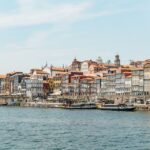
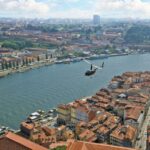
The church has a circular plan with a dome surrounded by a balcony, and the cloister is circular with 36 Ionic columns, described as the only example of this type in Portugal. The big win is the view from the terrace: you can see the riverside area of Porto and Gaia out toward the Arrábida Bridge, with the cathedral and Dom Luís I Bridge in the frame. Looking the other direction, you’ll spot Fontainhas and the São João bridge.
This viewpoint is 15 minutes and it’s time worth every minute. It’s where Porto finally clicks into place: you understand why the bridges matter, why the neighborhoods stack the way they do, and why people keep coming back for photos from this exact angle.
Dom Luís I Bridge and the modern iron arch: two eras, one crossing
After the viewpoint, you’ll ride past Porto’s most famous bridge story.
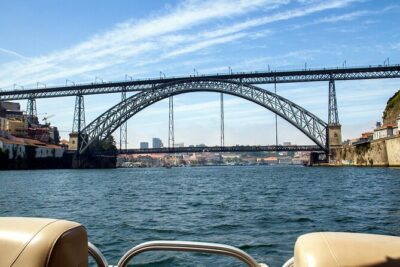
The Dom Luís I Bridge was planned by engineer Teófilo Seyrig, a disciple of Eiffel, and inaugurated in 1886. It has two overlapping iron decks, and it’s built around a massive forged iron arch. The upper deck now carries the Metro of Porto, connecting near the Cathedral area to the Garden of Morro and Avenida da República in Vila Nova de Gaia.
The tour also includes a second major crossing: the 2003 bridge inaugurated 30 March 2003 and designed by engineer Adão da Fonseca. It replaced the upper deck lane of Dom Luís I Bridge, described as now used by metro line D. This newer span is a Maillart-type arch bridge, with a 371 m deck length and 20 m width, and an arch span of 280 m, noted as a world record for its type. It connects Fontainhas to Oliveira do Douro in Vila Nova de Gaia.
If you’re the kind of person who likes structure and engineering details, this is the payoff segment. You’re not just seeing a bridge; you’re seeing how Porto’s transport needs shifted and how design adapted.
Price and value: what $42.33 buys you, and what it doesn’t
At about $42.33 per person for roughly 1 hour 50 minutes, this tour can be great value if you’re trying to maximize sight coverage without spending the whole day walking.
You get:
- a port wine glass
- a driver/guide
- a local guide
- mobile ticket convenience
You don’t get monument entrances (so you should treat ticketed interiors—like the cathedral complex choices and some church towers—as optional extras). That matters because the “true cost” depends on how many indoor stops you add during the tour versus saving them for later.
From a planning standpoint, I think the sweet spot is a first or second day in Porto when you want orientation fast. If you already know the city well and you only want deep museum time, you’ll likely get less satisfaction from the short stop format.
Sound, timing, and weather: the real-world trade-offs
The biggest practical issue isn’t the itinerary; it’s the reality of small vehicles and changing conditions.
A few guides have been praised for energy and for pointing out good photo spots, including multiple mentions of guides like Victor, Natalia, Anna, Ana, Bernardo, and Gonçalo. Still, you can’t control everything: one concern that pops up is hearing commentary clearly inside the moving Tuk Tuk, especially if it’s windy, traffic slows, or the vehicle is packed.
Traffic can also affect timing. Some tours run into congestion late, which can reduce time for the last few sights. That’s normal for central Porto. If you’re keeping a tight schedule after the tour, I’d avoid booking a right-after appointment in the city center.
Weather matters too. Porto’s day can turn fast. One review specifically calls out a wet and windy day, and that experience still worked out, but it’s smart to bring a raincoat so you stay comfortable while you’re getting in and out for those quick stops.
Who should book the Porto historical center Tuk Tuk tour
This tour makes sense if you:
- want a quick overview of Porto’s layout and key landmarks
- prefer less walking for health reasons or plain fatigue
- like mixing famous stops with shorter, less-expected sights
- are traveling as a family (children must be accompanied by an adult, and multiple positive reviews mention young kids enjoying the ride)
You might want to think twice if you:
- want long museum time at each stop
- struggle with short viewing windows and prefer slower, deeper visits
- need a quieter, fully narrated experience where you can hear every detail without background noise
Should you book this Tuk Tuk tour?
I’d book it if your goal is getting your bearings fast and seeing a strong slice of Porto in under two hours. The included Port wine, the ability to roll into tighter streets, and the standout viewpoint at Serra do Pilar make it feel like more than just a basic sightseeing loop.
I’d hold off if you’re already in Porto long enough to plan indoor time at each major monument. In that case, you may prefer a slower day that pairs walking with specific ticketed visits.
If you book, I suggest one simple strategy: treat the tour as the map-maker. Let it show you what’s worth returning to, then build your extra time around the places that grab you.
FAQ
How long is the Tuk Tuk tour in Porto?
The tour lasts about 1 hour 50 minutes (approx.), with the timing of stops subject to local traffic conditions.
Is Port wine included?
Yes. A glass of Port wine is included in the tour.
What language is the tour offered in?
The tour is offered in English.
Are entrance tickets to monuments included?
No. Monument entrances are not included. The tour notes some stops where admission is free and others where tickets are not included.
Where does the tour start and end?
It starts at R. de Augusto Rosa 180, 4000-528 Porto, Portugal and ends back at the same meeting point.
Is this a private tour?
Yes. It’s a private tour/activity, meaning only your group participates.
How many people can fit in each Tuk Tuk?
Each Tuk Tuk has capacity for 2, 3, or 4 adults of average height (up to 75 kg each). Larger groups use multiple vehicles while keeping the same stops and timing.
What if the weather is poor?
This experience requires good weather. If it’s canceled due to poor weather, you’ll be offered a different date or a full refund.